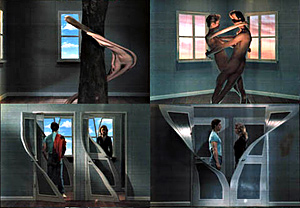
This video similarly to Viola plays with nature and special effect.
No scene cut can be seen during the full length of the video. Due to the fact that the set is entirely outside in nature, this effect seems to be even more impressive.
"The Man with the Movie Camera" is a documentary by the Russian director Dziga Vertov from 1929. Though most movies at that time dealt with politics, this movie shows the urban life in various Soviet cities.
My dog just cannot stop moving in front of the camera, just like cars and people walking in the street.
By changing the ISO o my camera to around 100 or 200, depending on the light, the camera is hardly able to be handheld and any movement in front of the camera gets blurred.
This effect could be intended when approaching to visualize specific moods, such as tiredness, movement or dreaming.
I am still experimenting with the shadows on my wall. They seem to fascinate me. I am taking continuous pictures with my camera and then put them all together with the aid of iMovie a film editing program. The minimum time possible to set is 0:36 seconds. This setting makes out of around 150 pictures worth one minute.
This stop-motion animation is definitely worth having a look at. It may not be as difficult to reproduce and further development such as different color candles can easily be added.
Reflecting pool by Viola is an interesting example for light, nature and special effects. The special effects are not as obvious, which makes the video more interesting.
soundtrack of the movie "Les pupees russes" ("l'auberge espanole")
I very much like the song as well as the effects used in the video.
Different scenes seem to be blended into each other, an interesting use of light is approached and it is not a "smoothly" recorded film, but highly sequential.
Hopefully, I will be able to adapt a few of this video's characteristics with the tools available to me.
I could try to produce a video with continuously taken photos of plays of lights.
Then in between these pictures, another story line could be placed, so only every other picture is of changing lights.
An example of recording the movement of little rainbows created with crystals.
Even if the video is played faster, it does not seem to have any effect on the viewer. It could be that by applying suitable transitions, an effect may occur.
"The Fourth Dimension" is one of Zbig Rybczynski's most striking films. He used a so-called slit-scan technique. The video is shot as normal, but during the printing phase, the images are "divided" into 480 horizontal lines. When reproduced, each image is delayed by one frame. The highest line is 480 images before the lowest line.
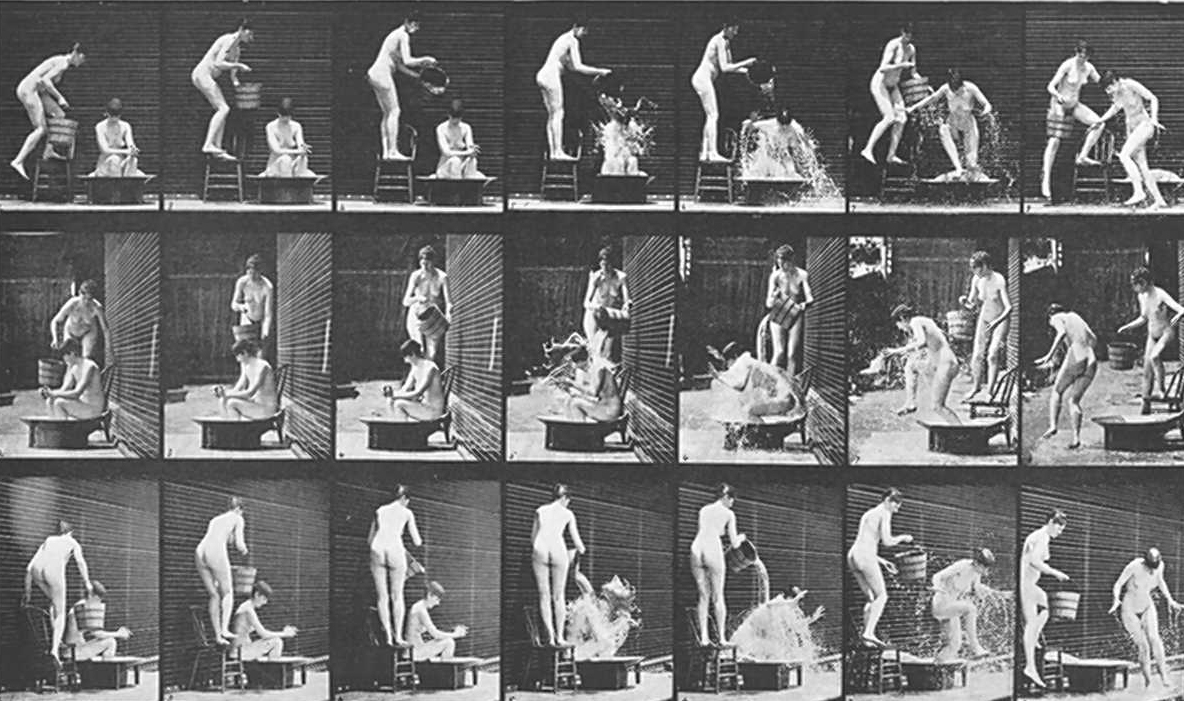
Eadweard Muybridge was an English photographer, who is known for the early use of multiple cameras for capturing motion and the from him developed zoopraxiscope, which can project motion pictures. He can lso be seen as the inventor of the moving image.