Saturday, 8 November 2008

Man Ray - Surreal Photograohy, Solarizatioin

I am finding Man Ray very inspiring. The potential he had in experimenting with different media and techniques is enormous. Solarization, for example, which used to be quite a long process he used for his photographs, can very easily be applied to film with simple programs. To achieve a particular mood, this may be helpful.


Surrealistic painting as shown in this short video can express humor as well as cleverness. To be able to adapt a little bit of this atmosphere in a short movie would be great.

Monday, 3 November 2008

Streets of London

If I decide to do a film using different scenes in London, this song may inspire me.

Have you seen the old man 
In the closed-down market 
Kicking up the paper, 
with his worn out shoes? 
In his eyes you see no pride 
Hands held loosely at his side 
Yesterday's paper telling yesterday's news 

Chorus: So how can you tell me you're lonely, 
And say for you that the sun don't shine? 
Let me take you by the hand and lead you through the streets of London 
I'll show you something to make you change your mind 

Have you seen the old girl 
Who walks the streets of London 
Dirt in her hair and her clothes in rags? 
She's no time for talking, 
She just keeps right on walking 
Carrying her home in two carrier bags. 

Chorus

In the all night cafe
At a quarter past eleven, 
Same old man is sitting there on his own 
Looking at the world 
Over the rim of his tea-cup, 
Each tea lasts an hour 
Then he wanders home alone 

Chorus

Have you seen the old man 
Outside the Seaman's Mission 
Memory fading with the medal ribbons that he wears 
In our winter city, 
The rain cries a little pity 
For one more forgotten hero 
And a world that doesn't care 

Chorus

Proposal

For my final assignment I favor a "photo animation". I purchased a digital SLR camera recently and would like to experiment with its settings. With the aid of the camera as well as some film editing software I seek to dramatize the story line. The plot does apply to everybody. Anybody who is experiencing a bad day, which does happen from time to time, will feel involved. I would like to present incidents that everybody can associate with and intend to express them creatively.


Camera


The camera I am going to use is a Canon EOS 1000D. It is supposed to be a great camera for beginners of digital photography and offers sufficient adjustable manual settings to explore multiple functions.


One of the features I would like to base my filming on is its ability to take 3 pictures a second. However, if the ISO, for instance, is set to 100 or 200 and there is not a lot of light, the shutter time will automatically increase and 3 pictures wont be possible to take.


There are various basic, but essential adjustments you can make.


First of all the exposure. Exposure can only be understood, if all its components are known. There are three aspects that all respond to light and will have a great impact on the picture taken. Bryan Peterson illustrates these in his so-called exposure triangle.


First of all, the ISO, as mentioned above, can be seen as the digital camera sensor’s to light. Secondly, he aperture is the size of the hole that lets light enter the camera when a picture is taken. Lastly, the shutter speed is the time the shutter is open.


Depending on the scene, I am going to adjust these three features trying to express specific moods. If the ISO is set to low level, images are very likely to look blurred, for example. This phenomena could help me express tiredness or motion.


The camera is always going to be held at head-hight and will move with the observer, so he has the main character’s view and feels more integrated. It could even be fixed on top of my head to achieve a more authentic experience. The main character wont be visual at any point.


Additional effects


The pictures will be taken at a reasonable file size in JPEG format. Then they will be imported into iMovieHD and their duration will probable be set to about 0.3 seconds. In case the speed is not appropriate, the exported mpeg file’s speed can still be altered.


In addition to the camera’s effects, I am also going to edit scenes in applications, such as After Effects, iMovie and iMovie HD. Color alteration, solarization and brightness/contrast will definitely play part in the post production. Depending on the scene, I am going to determine which effects are suitable.


Time-lapse


Since each frame i.g. photo is captured far slower than it will be reproduced, it is the process of time-laps. Usually this technique is used for showing slow movements, such as cloud movement, plant growth or the construction of buildings. In this case, the progression of a whole day’s misfortunes is shown.


The use of time-lapse wont make the video look smooth. A tripod may be used at some point if the scene requires that.


Sound:


For presenting the story successfully, I will definitely employ sound too. The samples will not represent the exact event. Nevertheless, they intend to help the viewer follow the storyline. Sound will be applied moderately, so it does not distract from the visuals.


Inspiration


For the movie’s theme, I was also looking at some surrealist artists, such as Man Ray. He was experimenting with photographic techniques at the highest level and can be seen as extremely influential in photography. He is most-known for his solarized photographs.

Some surrealistic movies have a particular type of humor, which I would like to apply to my movie too. Whereas in surrealistic movies rather strange events take place, in “One of those days” ordinary things will be shown. However, the tone of presentation will hopefully make it look more unexpected.


For more influential artists and works, please consider my blog.


http://t-based-i.blogspot.com/


Story


As I have indicated above, the story is about a person getting through a day when everything goes wrong that could possibly go wrong. I am sure it happens to most people. Once the day starts, it seems as if nothing works out the way it should.


My aim is to show these typical bad luck or clumsy events within sequences that are quickly following up each other.


Obviously, the volume of the unlucky events is far exaggerated. Therefore, as a whole the film is intended to act comical.


As a result of watching this movie, people might realize that after all one day of your life is very short and that small misfortunes should not have an impact of our happiness.


Storyboard


The storyboard can be found attached. Nevertheless, so far it is only a guideline. Gathering ideas has not stopped. The effects I imagine to go with the particular scene are likely to be altered, since the detailed look of every scene is not yet explicit. It will definitely be updated and more details will be added during the process of making.


http://digital-photography-school.com/blog/learning-exposure-in-digital-photography/


http://www.whydidthechickencrosstheroad.com/sounds/roosters/


http://en.wikipedia.org/wiki/Time-lapse


Thursday, 30 October 2008

Lovely film, great music

This video similarly to Viola plays with nature and special effect.
No scene cut can be seen during the full length of the video. Due to the fact that the set is entirely outside in nature, this effect seems to be even more impressive.

Monday, 27 October 2008

The Man with the Movie Camera

"The Man with the Movie Camera" is a documentary by the Russian director Dziga Vertov from 1929. Though most movies at that time dealt with politics, this movie shows the urban life in various Soviet cities.

"This film is famous for the range of cinematic techniques Vertov invents, deploys or develops, such as double exposurefast motionslow motionfreeze framesjump cutssplit screensDutch angles, extreme close-upstracking shots, footage played backwards, animations and a self-reflexive style (at one point it features a split screen tracking shot; the sides have opposite Dutch angles)."


Friday, 17 October 2008

CCTV

Nowadays, many filmmakers deal with the controversial topic of CCTV.
"Britain reportedly has 4.2 million cameras, 20% of the world's CCTV, and one camera for every 14 people." - SHOCKING'

Andrea Arnold's "Red Road" is about a woman, ho is a CCTV operator. One day she recognises somebody criminal, so she tries to get involved.

Sunday, 12 October 2008

Movements recorded by camera

"the faceless dog" ;-)

My dog just cannot stop moving in front of the camera, just like cars and people walking in the street.

By changing the ISO o my camera to around 100 or 200, depending on the light, the camera is hardly able to be handheld and any movement in front of the camera gets blurred.

This effect could be intended when approaching to visualize specific moods, such as tiredness, movement or dreaming.

Rainbows on my wall 2

I am still experimenting with the shadows on my wall. They seem to fascinate me. I am taking continuous pictures with my camera and then put them all together with the aid of iMovie a film editing program. The minimum time possible to set is 0:36 seconds. This setting makes out of around 150 pictures worth one minute.


Saturday, 11 October 2008

Another play of lights

Candle lights at their best performance.
This stop-motion animation is definitely worth having a look at. It may not be as difficult to reproduce and further development such as different color candles can easily be added.

Bill Viola - Reflecting Pool

Reflecting pool by Viola is an interesting example for light, nature and special effects. The special effects are not as obvious, which makes the video more interesting.

Music for dreaming

Beth Gibbons - Mysteries
soundtrack of the movie "Les pupees russes" ("l'auberge espanole")


I very much like the song as well as the effects used in the video.
Different scenes seem to be blended into each other, an interesting use of light is approached and it is not a "smoothly" recorded film, but highly sequential.

Hopefully, I will be able to adapt a few of this video's characteristics with the tools available to me.

Light-Rainbows


watching rainbows on my wall...
I could try to produce a video with continuously taken photos of plays of lights.

Then in between these pictures, another story line could be placed, so only every other picture is of changing lights.


An example of recording the movement of little rainbows created with crystals.

Even if the video is played faster, it does not seem to have any effect on the viewer. It could be that by applying suitable transitions, an effect may occur.

Friday, 10 October 2008

Zbigniew Rybczynski - The Fourth Dimension

"The Fourth Dimension" is one of Zbig Rybczynski's most striking films. He used a so-called slit-scan technique. The video is shot as normal, but during the printing phase, the images are "divided" into 480 horizontal lines. When reproduced, each image is delayed by one frame. The highest line is 480 images before the lowest line.


EyesWeb

EyesWeb is an open-source software platform supporting the development of real-time interactive applications.

Friday, 3 October 2008

Eadweard Muybridge

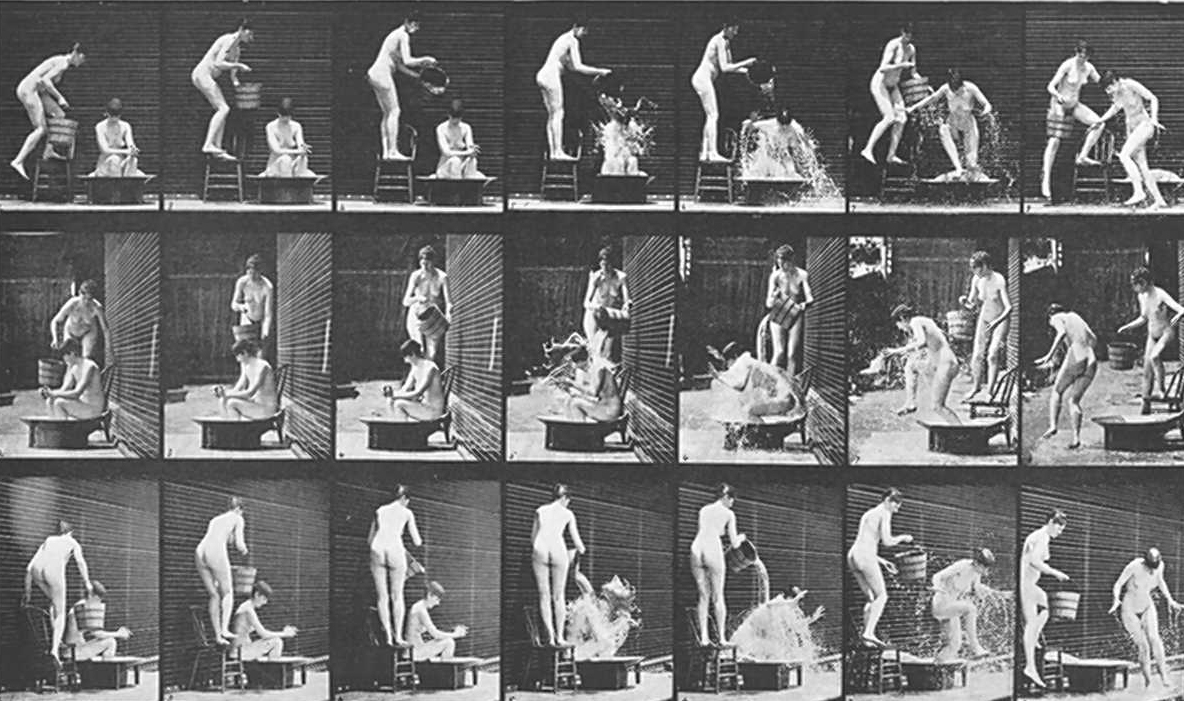
Eadweard Muybridge was an English photographer, who is known for the early use of multiple cameras for capturing motion and the from him developed zoopraxiscope, which can project motion pictures. He can lso be seen as the inventor of the moving image.

Here are some of his most popular photographs.

Image:The Horse in Motion.jpg